
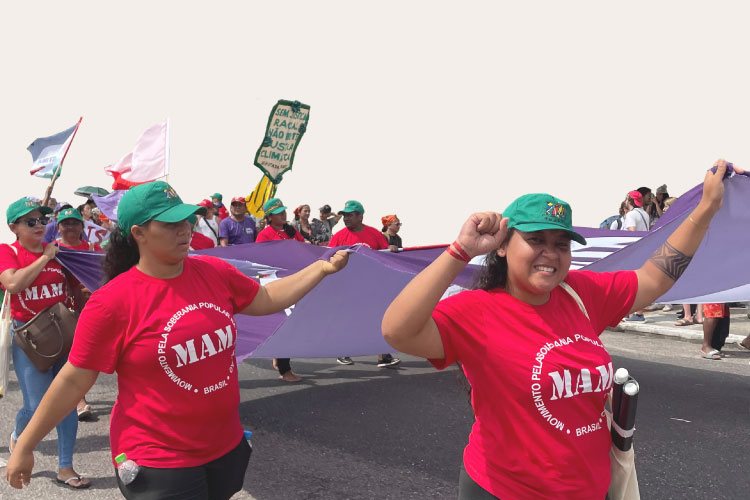
We spoke with activists, land defenders, farmers, fishermen, etc., to collect voices from Brazil regarding the green transition. The colleagues interviewed agree that the urgency of the transition ultimately responds to the thirst for profit of large companies and is leaving aside other social and climate priorities.
What do the activists and defenders of territory in Brazil think about the climate emergency and the green transition? How is this transition experienced here, in the country that welcomed COP30 with a grand speech about the climate while continuing to invest in a developmentalist model? What alternatives are communities building? We are convinced that we have a great deal to learn from Brazil’s peasant, Indigenous, and community struggles, and that this will help inform our debates on climate justice. Therefore, we would like to record some of the reflections shared by activists, defenders of territory, and community leaders.
From 27 October to 22 November 2025, a team from ODG travelled throughout Brazil to encounter movements resisting rare earth extraction and to take part in the People’s Summit that took place during COP30 in Belém. We spent time in the Extremo Sul de Bahia region, at an MST school where we participated in a training programme alongside members of MAM and where resistance to the mining of rare earths is taking shape. We also visited Goiás state to witness the impacts of the extraction of niobium in the municipalities of Catalão and Ouvidor where, furthermore, there are now plans to extract rare earths. This document includes the voices of some of the activists we met.
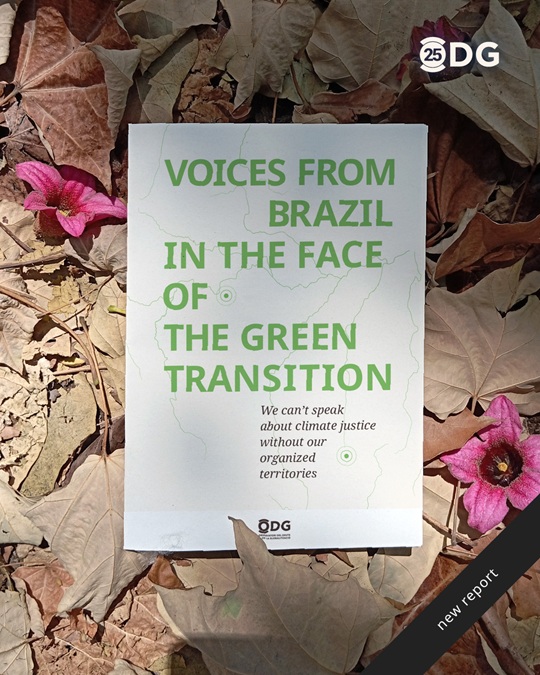
The report is available in Catalan, Spanish, English, and Portuguese. Besides, we produced a summary video with some of the key ideas arising from the trip in Brazil.
Who has participated in «Voices from Brazil in the face of the green transition»?
- Rikartiany Cardoso: lawyer and human rights expert, part of the national coordination of MAM, the Brazilian Movement for Popular Sovereignity in Mining.
- Ingrid Ãgohó: leader of the Pataxó people in the Extremo Sul de Bahia region.
- Simone Rodrigues: a popular educator, she is part of the national leadership of the Landless Workers’ Movement.
- Karina Martins: a professor and member of the national coordination of MAM.
- Erahsto Felício: educator and communicator in the organization Teia dos Povos, a network of rural and urban communities, peoples, and organizations.
- Ricardo Assis Gonçalves: researcher at Universidade Estadual de Goiàs.
- Marcos José de Oliveira: a farmer in the Catalão , affected by niobium and phosphate mining for over fifty years.
Supported by:



This publication was co-funded by the European Union, the Diputació de Barcelona, and the Rosa Luxemburg Foundation. Its contents are the sole responsibility of the Observatori del Deute en la Globalització (ODG) and do not necessarily reflect the views of the funders.