
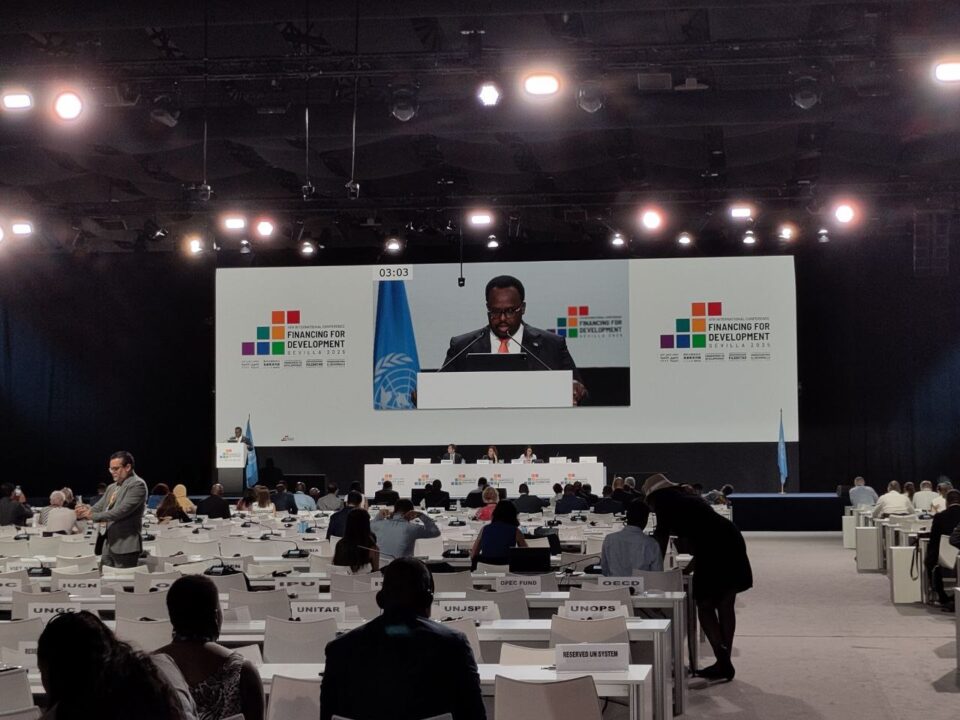
A team from the ODG has been covering #FfD4, the Fourth United Nations International Conference on Financing for Development, on the ground. We’ve summarised some key points from the Seville Commitment and are sharing videos of our coverage from Seville.
15.000 personas de 150 países, representantes estatales, más de 1.000 entidades de la sociedad civil y 6.000 delegadas del sector privado han participado en la Cuarta Conferencia de Naciones Unidos sobre Financiación para el Desarrollo (Ffd4 en sus siglas de inglés). De todas estas participantes, solamente las delegaciones oficiales de la ONU tenían voz y voto para aprobar el Documento final que tenía que salir de este encuentro, el llamado Compromiso de Sevilla. Los temas claves de esta conferencia incluían la deuda soberana, la fiscalidad internacional, la financiación de la cooperación al desarrollo y la reforma de las instituciones financieras internacionales. Así lo resumía Mar Sala, en una colaboración con la periodista audiovisual, para explicar qué ha pasado estos días en Sevilla.
15,000 people from 150 countries, including government representatives, more than 1,000 civil society organisations, and 6,000 delegates from the private sector, took part in the Fourth United Nations Conference on Financing for Development (FfD4). Of all these participants, only the official UN delegations had the right to vote on the final document to be adopted at this meeting, known as the Seville Commitment. The key issues at this conference included sovereign debt, international taxation, the financing of development cooperation, and the reform of international financial institutions. This is how Mar Sala summarised it in a piece co-authored with an audiovisual journalist to cover what has been happening over the last few days in Seville.
View this post on Instagram
However, the document had already been finalised before this multilateral meeting began. But the outcome could have been different, as behind the scenes, the Global South was tipping the balance towards a substantial reform of the economic and financial system and its governance. This was prevented by the obstruction of the Global North countries, particularly the EU and the UK. Nicola Scherer, an ODG researcher specialising in financial justice, summarises this in an article for Público:
“The key players — though largely overlooked — have been the alliances between states of the Global South, specifically the African Group (54 states), the Least Developed Countries (LDCs, 44 states) and the Alliance of Small Island States (AOSIS, 39 states). During the negotiations, they have supported transformative demands: to create a binding United Nations framework convention on sovereign debt and another on international development cooperation; to democratise the International Monetary Fund and the World Bank, giving countries of the Global South a voice and a veto; the need to rein in powerful private investment funds (such as Blackrock, JP Morgan, etc.) and regulate credit rating agencies (Moody’s, Standard & Poor’s and Fitch Ratings). Unfortunately, these demands were ultimately watered down in the Seville Commitment, or simply excluded, during the final round of negotiations, which took place behind closed doors fifteen days before the Conference.”
View this post on Instagram
Civil society has denounced the lack of ambition in the Seville Commitment through a historic demonstration; indeed, apart from the COPs, this was the first time a political rally had been authorised within the grounds hosting a UN summit. This action also highlighted the disparity in treatment meted out to corporate and financial powers: whilst civil society held its Social Forum two days before the official programme. In a hotel some distance from the FIBES, the UN allowed the private sector to organise its Business Forum on the very same days as the Conference and within the UN complex itself. For Scherer, this lays bare the complicity among multinationals, financial institutions, and the political arena of global decision-making.
As Stéfano Prato, spokesperson for the Civil Society Mechanism at this FfD4, explains, “there is no real democracy if civil society, with all its voices, experiences and stories, cannot participate deeply and meaningfully in the process” of the Seville Commitment. “We find ourselves relegated solely to the role of an audience, in which we can only listen to what member states are discussing. Meanwhile, they roll out the red carpet for private-sector participation,” he points out in the second collaborative video with Sala.
As a counter-proposal to more ambitious measures, creditor countries in the Global North offer false solutions such as debt-for-nature swaps, that is, the one-off cancellation of part of the external debt of impoverished countries in exchange for climate action (the protection of a forest, a marine reserve, etc.). These debt swaps have proved ineffective in resolving the debt crisis and have been criticised for lacking transparency, thereby perpetuating the power dynamics of creditor countries over debtor countries. Furthermore, we also denounce the lack of concrete action in implementing the Seville Commitment, as there is no clear roadmap on the table—with deadlines and monitoring mechanisms—outlining the next steps to be taken by the states participating in FfD4. We summarise the conclusions in this video with Mar Sala:
View this post on Instagram
The Feminist Forum and the Social Forum
One of the key issues at this UN conference has been the link between debt and the climate emergency. This has been particularly evident within the framework of the Feminist Forum and the Social Forum, organised outside the official FfD4 programme, with the participation of hundreds of organisations from all over the world.
“Debt and the climate emergency are closely linked. They form part of a vicious circle,” explains Carola Mejía, from Latindadd. “Heavily indebted countries are allocating more of their budget to repaying their debts than to education, healthcare and the climate agenda. They have less public money to respond to emergencies,” such as extreme weather events, which are on the rise. “When an event like that happens, they have to take on more debt,” says Mejía.
View this post on Instagram
Bonus track: How is the backstage of a UN Conference?
To round off this series, we’re sharing a vlog about these days at FfD4, capturing the atmosphere inside the venue and asking what impact events of this scale have on the local population.
View this post on Instagram
________________________________________________________________________________________________
Supported by:

This project is co-funded by the European Union. The contents are the sole responsibility of the Observatory on Debt in Globalisation (ODG) and do not necessarily reflect the views of the European Union.