In 2025, the city of Belem, in the State of Pará in Brazil, hosted the 30th United Nations Conference on Climate Change (COP30). After three years of COPs being held in countries with authoritarian regimes highly restrictive of civil society, this year’s summit was accompanied by large social mobilisation.
The country wants to position itself as a strategic actor for the global green transition. Given the high production of renewable energies, Brazil is a potential producer and exporter of green hydrogen, mainly to the European Union. In addition, it has reserves of several critical minerals, such as niobium (currently it produces 92% of the global total) or rare earths (estimated to own 23% of world reserves).
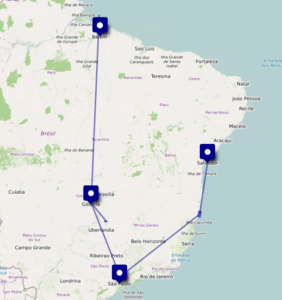
Following ODG’s work on rare earths and COPs, we planned a tour of strategic meetings across the territory to meet communities, before the conference (11-22 November). From October 27 to November 11, 2026, two members of ODG travelled through Brazilian territory to meet resistance struggles to rare earth extractivism. We created new connections, exchanged knowledge and built joint mobilization strategies. The tour passed through the States of Bahia and Goiás, stopped in São Paulo to participate in the anti-extractivist meeting co-organised with the Ecosocial and Intercultural Pact of the South, and ended in Belém, in the State of Pará.
Extreme Southern Bahia: popular organising against mining
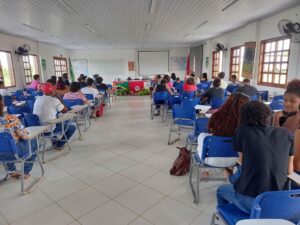
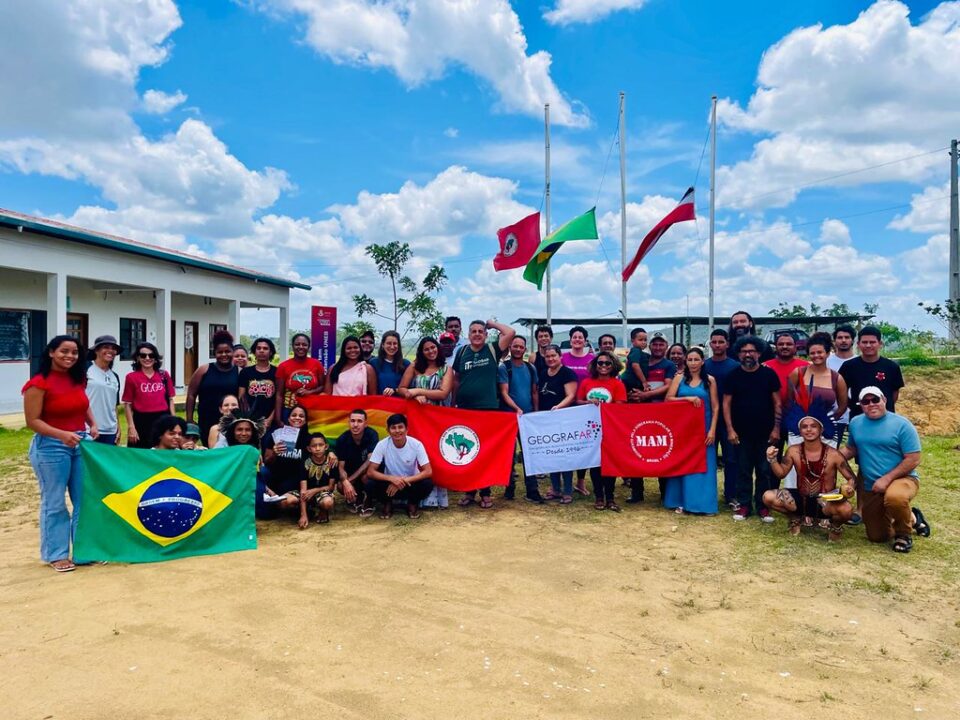
We met with activists from MAM, the Movement for the Popular Sovereignty of Mining, in Salvador de Bahia, to exchange experiences of resistance to extractivism and understand the political context. Afterards, we travelled to the southern region of this state. There, between the municipalities of Caravelas and Prado, we co-organized a Training School on rare earths, with the MAM and the MST (Movement of Rural Workers Without Land). There is a rare earth project in the area, owned by Energy Fuels, a US company that intends to extract ilmenite, rutile, zircon and monazite (which would contain rare earths). The company has an exploration permit but not yet for extraction. The seventeen concessions acquired by the company affect territories of the Pataxó indigenous people, as well as protected areas of artisan fishing and various settlements and land of the MST. Until now, the project was little known to local communities, but thanks to the school they began to articulate the resistance.
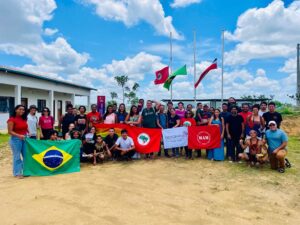
A total of 40 people participated in the school: members of the MST, the MAM, local councillors and representatives of indigenous communities. We shared the ODG’s work on rare earths, the experience of the communities of Madagascar fighting Energy Fuels portrayed in the report Neocolonialism in the name of the green transition, and we screened the documentary Land for Living (2025), which shows the voices of people resisting against three rare earth extraction projects in Madagascar.
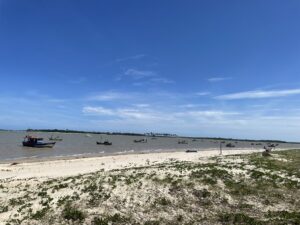
Lastly, we went to Caravelas guided by a school participant, to see an area which would be directly impacted by the construction of mining infrastructures. We also met an artisan fisherman from the protected reserve.
São Paulo: Green colonialism and post-extractivist transitions event
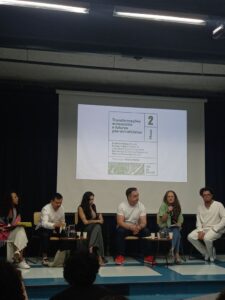
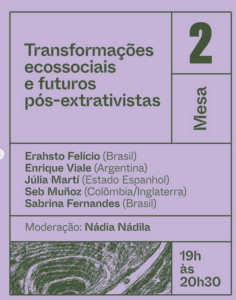
We continued the tour to Sao Paulo, to meet members of the Ecosocial and Intercultural Pact of the South, at the event Green Colonialism and post-extractivist transitions. ODG researcher Julia Marti gave a presentation at the table on Ecosocial Transformations and Post-extractivist Futures, highlighting the importance of opening a dialogue between feminist and territorial struggles, and the emancipatory potential to transform the care and reproduction system of life.
Goiás: from niobium mining to the invisible threat of rare earths
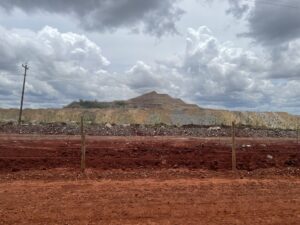
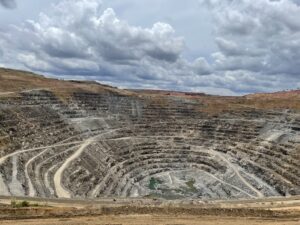
From São Paulo we went to Catalão, in the State of Goias, a region that has suffered for years the impacts of the extraction and processing of niobium, which is also considered critical, especially for military applications. Brazil is the world’s leading producer of niobium (90% of the total). We visited the existing open pit niobium mines, which have displaced 1,500 peasant families since their start 50 years ago. We were accompanied by Marco, a peasant whose family had been displaced at the beginning of the mine and who, now, will have to relocate again. Currently, there is a phosphate and niobium mine, operated by Mosaic (from the United States), and another operated by a Chinese company called China Molybdenum Corp, which had previously been owned by Anglo American. Both companies have shown interest in extracting rare earths from their mines.
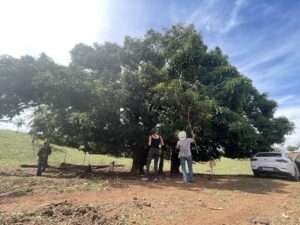
In fact, in the area there is a rare earth laboratory run by the Goiás administration, the government of Brazil and the university, a unique project of this kind in Brazil. However, the potential threat posed by the extraction of rare earths for the environment, daily life and health of communities is invisible and, for now, has not aroused large waves of resistance. Rare earths represent a very new subject and there is little knowledge. Mining (so far, of niobium and phosphates) is a reality in the area and the demands of the communities relate to better monetary compensations and the right to decide, but there is no frontal opposition. We interviewed Marco, an affected peasant, and Ricardo, a researcher at the University of Goiás (the capital) on mining. We also screened the short documentary Land for Living in Goiás, and discussed it with a group of researchers from the university of the capital.
Belém: social mobilisation for climate justice
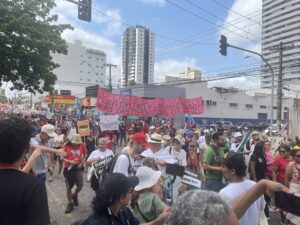
The final destination of the tour was the city of Belem, to participate in the People’s Summit, the mobilizations for climate justice which took place across the city and to follow and do communication work around the COP30 negotiations. A young Malagasy activist joined is in Belem; we shared mobilisation spaces and networking. Among others, we participated in actions of the Debt for Climate Campaign and the Fossil Free Politics coalition. We were also at the big rally that filled the streets of Belem on Saturday, November 15 to call for climate justice.
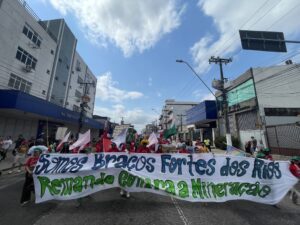
After this experience, ODG is committed to continuing to collaborate with the groups we have met, and to support the communities which defend their territories against rare earths’ extractivism, as well as to facilitate connections between the peoples of Madagascar and Brazil.
- For more pictures, see our Flickr.
- For more detailed information on Brasil’s green hydrogen and rare earths related plans, see the long read.
With the support of Rosa Luxemburgo Foundation.